YOUR FIRST AI AUTOMATION · BUILT FOR YOU
Less handling.
More happening.
One repeat job.
A better way to get it done.Still copying the same details
into different systems?A new enquiry.
A clearer next step.Know the task you want automated?
Get help building it.
We scope, build and test a useful automation around your tools—with the human checks where they matter.Bring one recurring task. We agree what should change, then build and test it around your tools, with the human checks you need.Connect the details, the people, and the follow-up. Start with one agreed process, with replies checked where needed.We help scope the job, connect the agreed tools, and test normal cases and exceptions with you.
Illawarra · South Coast through Batemans Bay · Sutherland Shire · Macarthur

Actual Poko interface · sample workspace. Your workflow and tools are scoped separately.
YOUR NEXT STEP
Talk to Poko.
Leave your details. We’ll reply about the fit and next steps.
RECOGNISE THE SITUATION?
The same job. The same copying. Again.
The request arrives. The handling starts.+
Details move between an inbox, a document and another record.
The exception waits for someone.+
A missing fact or unclear responsibility holds up the next step.
Nobody can see whether it worked.+
A task looks complete until someone checks the result.
ONE TASK. A CLEARER WAY THROUGH.
Less copying.
A process you can follow.
A worked enquiry example—not a connected system or customer result. Your own task, tools, scope, and full price are agreed first.
Before
An enquiry arrives. Someone copies the details, prepares a reply, and chases the next step.
After
The agreed process prepares the record and response, with the next owner visible.
Your control
A person checks the reply. Missing information or a failed step needs attention before it continues.
Scope agreed → build and test → handover and included monitoring
See the scope and testing checklistExplore the outcomes in more detail
- Choose a manageable first job
- Agree the task, the result and the exceptions before building.
- Connect the work
- Use the tools and information agreed in your scope.
- Keep a person in control
- Decide which actions need approval and what happens when something is unclear.
- Know how it runs
- Test normal cases and exceptions with us, then review the result in use.
Scope, arrangements, and the next step
The starting offer is one scoped automation, agreed connections, testing with your team, and two months of monitoring and fixes. Access, complexity, additional workflows, software, usage, handover, and ongoing support affect the full arrangement. We confirm what is included and any extra costs before work begins.
MAKE THIS ABOUT YOUR BUSINESS
Which recurring job would you change?
Choose your industry and explore one task you might ask us to build. Choose an example, or bring your own situation.
Examples are here to help you explore. You can enquire without choosing one.
Choose what feels relevant, or describe something different.
Describe a different recurring task ↗Your role, area of work, and next steps
MAKE THE APPROACH TANGIBLE
Follow a task through the checks.
Try a scripted example of the workflow. Nothing is sent, uploaded or changed in a business system.
- 1Enquiry arrives
- 2Prepare the record
- 3Draft a reply
- 4Person reviews
A fictional customer asks about your service. The workflow has approved service information to work from.
Your next step
Review the included details and add your contact information before sending.
HOW WE WORK TOGETHER
Scope it. Build it.
Test it with your team.
Agree the job
Describe what starts the task, what a good result looks like and what needs your approval. We confirm scope and the full price.
Build and test
Connect the agreed tools. Test ordinary cases, missing information and failures with you.
Put it to work
Introduce the agreed workflow and review it in use. Two months of monitoring and fixes are included.
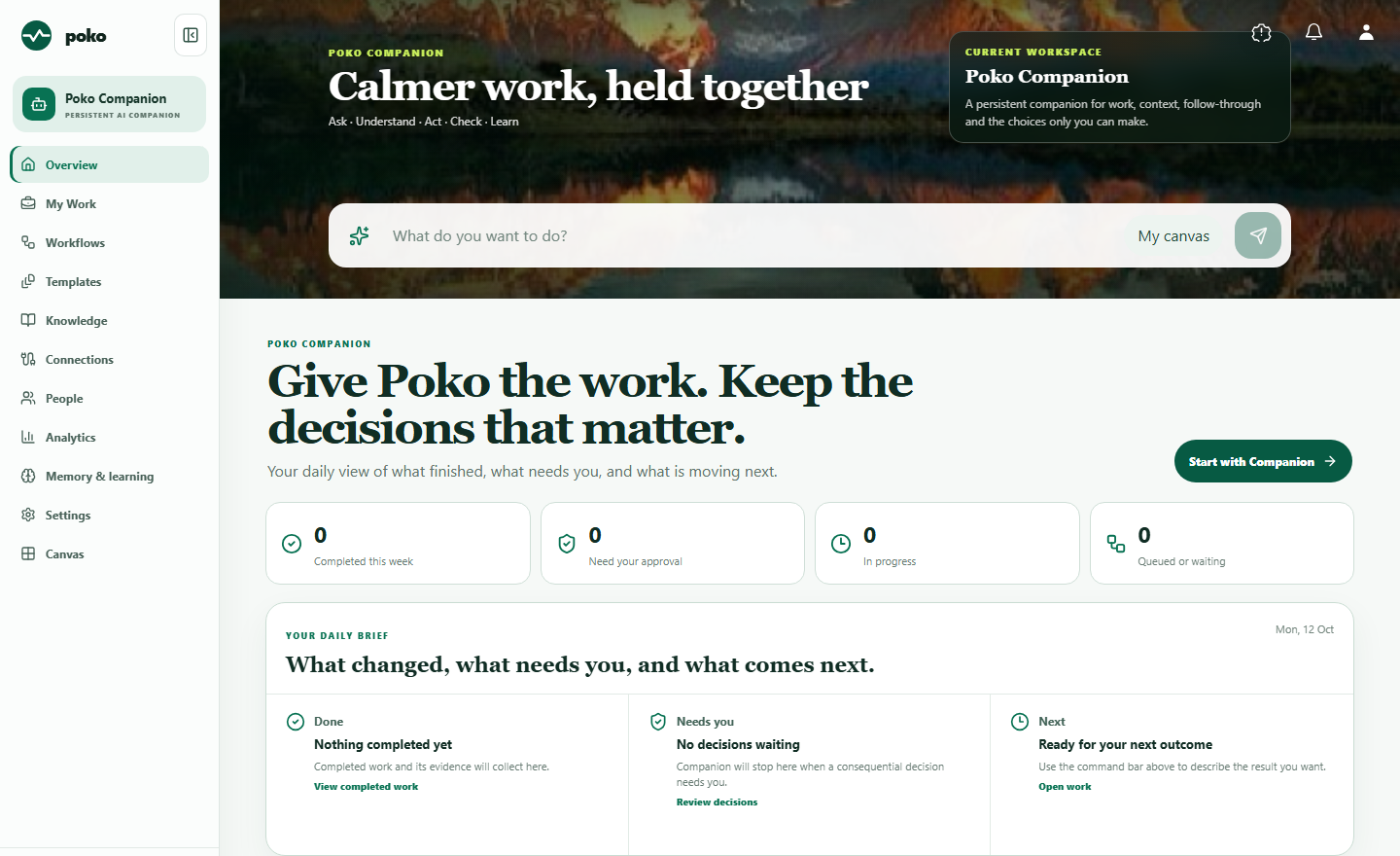
PEOPLE. TECHNOLOGY. WORKING TOGETHER.
Your existing tools.
One agreed improvement.
Start with the work, people and information involved. Agree the access, exception handling, ownership and full operating cost before the build.
Ask about the approach ↗Before you agree to a build
Know what is being built—and how it will be checked.
A useful first automation has a defined job, a clear review point and a way to handle exceptions. Use this sample scope checklist before agreeing a build.
01Define the job+
What starts it?
Which tools and approved information are involved?
What should be produced?
Who approves it?
What is outside scope?
02Test ordinary and awkward cases+
Try a normal input, missing information, a duplicate, a failed connection and a rejected draft. Agree what should stop, who is notified, how to retry safely and how the result will be checked.
03Agree the operating arrangement+
Confirm access, licences and usage costs. Identify the person responsible, human checks, handover, included support and the arrangement after it ends. A checklist is not an accepted scope or guarantee.
Text file · 3 templates · no email required
UNDERSTAND THE INVESTMENT
Would this job
justify the build?
Start with a worked example. Adjust your time, people and costs; inspect the sources and assumptions.
Your business case
Would this task justify an automation?
Start with the time tied up in a recurring task. Include review time, running costs and how much capacity you could actually recover.
A worked example is ready below. Adjust the time, people and costs to your situation.
Starting figures & sources
This is a worked example, not an expected result from this offer. The 25% recovery share, people count and 46 working weeks/year are editable assumptions. Zero extra costs and no benefit delay mean those costs and delays have not been entered.
- Airtasker founder research, reported August 2026: 254 founders averaged 19.5 hours/week of delegable work. This is broader than administration or any single task; it is not all recoverable.
- Allianz / YouGov, 2025: employees self-reported 3.31 hours/week on unnecessary tasks and meetings. This is a broad reference, not the measured time for your task or your industry.
- ABS May 2026: A$2,083.70 average full-time ordinary weekly earnings ÷ an assumed 38 hours = A$54.83/hour. An employee-pay proxy, not owner earnings or a charge-out rate.
- ABS August 2025: A$42.90 median hourly employee earnings, excluding employer on-costs.
Replace the broad employee time reference with the time for your specific recurring task before assessing a build.
The work behind this example
Name the work or change
Estimate the time involved
Go deeper: owner & team breakdown
Separate roles with different time costs. Count each person and task once. Use role labels, not people’s names.
Allow for what actually changes
Period, full costs & time before benefits
Go deeper: could this change money?
Financial hours are capped at recovered capacity. More sales need demand; a salary only becomes a saving if spending actually falls.
Your scenario · not a forecast
Enter your figures to see an estimate.
Recovery share not yet calculated
- Potential recovered time
- —
- Capacity value over the period
- —
- Total scenario cost
- —
- Capacity-value return after costs
- —
- Capacity value after costs
- —
- Financial ROI
- Not modelled
Enter time and hourly value to compare with the investment.
Recovered time is capacity, not automatically cash saved or revenue earned.
Your inputs, assumptions and results can be reviewed with your enquiry before you send it.
Test the assumption
What if less—or more—of that time is recovered?
Three versions of your estimate. Same costs and timing; a different recovery share. These are illustrations, not probabilities or promised results.
Lower recovery
—Add your figures aboveYour estimate
—Add your figures aboveHigher recovery
—Add your figures aboveExplore the calculations, assumptions & limits
Time: weekly hours × people × recovery share. With a team breakdown, each role’s weekly hours and hourly value are calculated separately, then added. Each role should describe different work so it is not counted twice.
Benefit weeks: working weeks per year × months ÷ 12, less working weeks before benefits begin, with a minimum of zero. Capacity value: recovered weekly hours × hourly value × benefit weeks. All service, one-off and monthly costs remain included over the whole scenario period.
Capacity-value return: (capacity value − costs) ÷ costs. It is not financial ROI. The weekly time needed to match cost is costs ÷ hourly value ÷ benefit weeks; a team uses a time-weighted hourly value. This threshold is a capacity comparison, not cash payback.
Financial ROI is only modelled with your cost-reduction or additional-contribution mechanism. Financial hours are capped at recovered time. Financial benefit = capped hours × financial value per hour × benefit weeks. Financial ROI = (financial benefit − costs) ÷ costs. Zero cost has no meaningful percentage return.
The comparison varies recovery by 25 percentage points either way, capped at 0–100%. No result is assigned a likelihood. The model assumes a constant recovery after the entered delay; it does not model a gradual adoption curve, discounting or tax adjustments. Use consistent GST treatment. Training and coaching do not guarantee these outcomes.
Everything runs on this page. Figures are not sent until you explicitly include, review and submit them with an enquiry. Changes stay here while the page is open; they are not saved across a reload.
PRICE & NEXT STEP
One scope. An agreed price. A clear next step.
Your First AI Automation
From A$3,290
Including GST · one agreed automation
What is included
- Help choosing the first task
- One automation, scoped before work begins
- Connections to the tools agreed in your scope
- Testing with your team
- Human checkpoints where needed
- Two months of monitoring and fixes
Scope, arrangements & payment stages
The price depends on the task, systems, access and complexity. Software licences, external usage costs, additional workflows and ongoing care after the included period are agreed separately.
For an agreed A$3,290 scope: A$987 at commencement, A$658 on approval of the proposed work, and A$1,645 within seven days of delivery. We confirm your actual scope and amounts in writing.
Review the service, then continue to booking and secure payment when you’re ready.
Already have something in mind?Shape a brief to send with your enquiry+
Start with how your work actually happens
What would you like to take off the manual list?
It could involve information, decisions, content, customers or something specific to your business. Describe your job in ordinary language; we can explore the tools and feasibility together.
Shape your starting brief
A sentence or two is enough. Keep confidential customer, staff and health details out.
Stays on this page until you choose to include it and send an enquiry.
Your starting point
Your first automation starting brief
Your words will appear here as a starting brief. We can use it to explore the fit, scope and next step with you.
- What starts the job?
- What needs to happen?
- What should the result be—and who checks it?
This organises what you supplied. It is not an assessment, recommendation, agreed scope or quote.
Review the included details with your enquiry before sending.
YOUR NEXT STEP
What would you like
to put to work?
Tell us about the work. A short brief is enough to start.
Review any examples or estimates you chose to include. No need to complete an exercise, arrange a meeting or pay to enquire.
Your enquiry stays together.
The details you chose to include are ready to review in the form at the top. You can edit or remove them before sending.
Review and send my enquiry ↗THE DETAILS, WHEN YOU WANT THEM
Before you decide.
Do I need to know what to automate?
A description of a recurring task is enough to start. We help work out whether it is a suitable first job before agreeing the work.
Will this replace my existing tools?
We first look at what you already use. Any replacement, new licence or external cost needs to be agreed in the scope.
Will AI send things without checking?
We agree the approval points. For example, a workflow can draft a reply for a person to check rather than send it automatically.
What if it fails?
The scope should identify exception handling, the person notified and how to recover. We test these cases with you; monitoring and fixes are included for two months.
How much time will it save?
That depends on the task and how often it runs. Establish a baseline and measure the actual result, including review time. We do not promise a saving before understanding your work.
Prefer to keep in touch? Dave’s Notes
Before you book
Your enquiry is separate from a booking, payment or agreement to start work. We confirm the scope, arrangements, price and terms with you before you commit.
You can ask a question without paying, or continue through Poko’s booking and secure payment flow. A payment receipt and a confirmed appointment are separate records.
Illustrations and interactive examples show an approach; they are not customer results.