PRIVATE BUSINESS & EXECUTIVE COACHING
Big decisions.
Better thinking.
The decision is yours.
The thinking can be shared.A big business decision?
Talk through the options with Dave.Too many priorities.
What comes first?Does every decision
still come back to you?
Ten private sessions with Dave to examine the options, choose a practical step and return to what happens.Examine the trade-offs, identify what you need to know, and choose a practical next step. Return to what happened in later sessions.Step back from the competing demands. Work through your options with Dave and choose what happens next.Work through what needs your judgement, what your team could own, and the responsibilities you want to clarify.
Illawarra · South Coast through Batemans Bay · Sutherland Shire · Macarthur
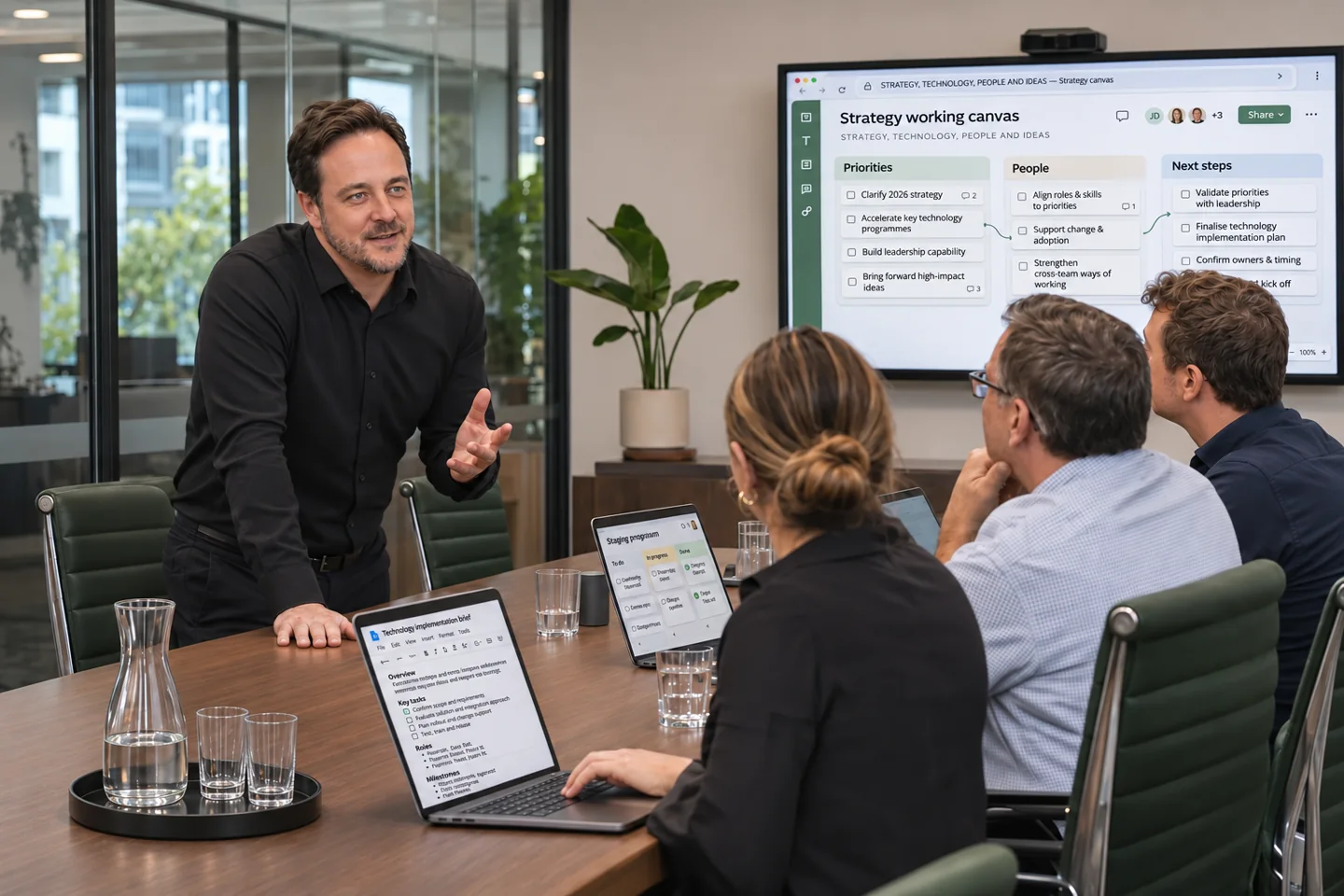
Strategy. Technology. Decisions.
- The decisionClarify the question and trade-offs.
- The optionsExamine evidence and assumptions.
- The next stepChoose what to try, then review.
Illustrative approach · not an automated recommendation
YOUR NEXT STEP
Talk to Poko.
Leave your details. We’ll reply about the fit and next steps.
RECOGNISE THE SITUATION?
When the decision keeps coming back to you.
The options keep circling.+
You can see the competing priorities. Choosing between them still needs work.
There is nobody neutral to work it through with.+
The decision affects the people who would usually be your sounding board.
The next urgent thing takes over.+
You make a choice, but the follow-through disappears into the week.
A WORKING RELATIONSHIP WITH DAVE
Think it through.
Choose your next step.
Ten private, 60-minute sessions for business strategy, leadership, and technology decisions. The questions come from your business.
A question to work through
Clarify the decision, constraints, people, and options.
An action you choose
Test your thinking and agree what you want to try in your own work.
A place to return
Review what happened and adjust your next step through the programme.
Ask about fit → review arrangements → book and pay when ready
Meet Dave and explore his backgroundExplore the outcomes in more detail
- A consequential decision
- Work through options, trade-offs and the evidence behind your choice.
- Competing priorities
- Choose what comes next, what can wait and what needs a different approach.
- A leadership conversation
- Prepare for expectations, delegation, boundaries or a difficult discussion.
- Practical follow-through
- Review what happened, understand what helped and adjust the next step.
Scope, arrangements, and the next step
Dave Morris is Poko’s founder. Explore his background and ask about relevant experience for your situation. Agree session spacing, availability, the programme window, confidentiality arrangements, and cancellation terms before payment. Hands-on implementation is a separate service.
MAKE THIS ABOUT YOUR BUSINESS
Which decision would you like to work through?
Choose your industry and explore questions about direction, leadership and your role in the business. Choose an example, or bring your own situation.
Examples are here to help you explore. You can enquire without choosing one.
Choose what feels relevant, or describe something different.
Bring my own question or decision ↗Your role, area of work, and next steps
MAKE THE APPROACH TANGIBLE
Explore how a conversation could begin.
A fictional example of coaching—not an assessment, automated advice or the only topics you can bring.
A fictional starting question
Do we add a new service—or test demand first?
What would need to be true for each option to make sense?
Choose what evidence to gather before making the larger commitment.
Bring your own question
Stays on this page until you choose to add it to your enquiry. It is not assessed or scored.
Your next step
Review the included details and add your contact information before sending.
HOW WE WORK TOGETHER
Ten working sessions.
Decisions you can act on.
Agree the focus
Describe the situation and what useful progress would look like. Decide what to work towards together.
Work through and apply
Examine your options. Choose an action or experiment to try in your own work.
Return and adjust
Review the result, revisit assumptions and work through the next decision.
PEOPLE. TECHNOLOGY. WORKING TOGETHER.
Business strategy.
Technology. Action.
Work through business direction, technology choices and operating decisions with Dave. Agree the setting, participants and priorities before the sessions begin.
Ask about the approach ↗Prepare for a working session
A decision on the table. A next step that is yours.
You do not need to arrive with a polished answer. This sample working page gives a live business question some shape before a conversation with Dave.
01Name the decision+
The decision or situation:
Why it matters now:
What useful progress would look like:
The constraints and people involved:
02Explore the options+
Options to examine:
What we know:
What we assume:
What evidence is missing:
The trade-offs to discuss:
03Return to what happens+
A step or experiment I choose:
What I will observe:
Who needs to be involved:
When to review it:
What would change my mind:
Text file · 3 templates · no email required
UNDERSTAND THE INVESTMENT
What change in your work
would make this worthwhile?
Start with a worked example. Adjust your time, people and costs; inspect the sources and assumptions.
Your business case
What could a workable change be worth to you?
Use a time-based scenario for a change you want to make. This does not estimate the value of judgement, wellbeing or the coaching relationship, or claim that coaching will create the entered result.
A worked example is ready below. Adjust the time, people and costs to your situation.
Starting figures & sources
This is a worked example, not an expected result from coaching. The 25% recovery share, people count and 46 working weeks/year are editable assumptions. Zero extra costs and no benefit delay mean those costs and delays have not been entered.
- Airtasker founder research, reported August 2026: 254 founders averaged 19.5 hours/week of delegable work. This is broader than administration or any single task; it is not all recoverable.
- Allianz / YouGov, 2025: employees self-reported 3.31 hours/week on unnecessary tasks and meetings. This is a broad reference, not the measured time for your task or your industry.
- ABS May 2026: A$2,083.70 average full-time ordinary weekly earnings ÷ an assumed 38 hours = A$54.83/hour. An employee-pay proxy, not owner earnings or a charge-out rate.
- ABS August 2025: A$42.90 median hourly employee earnings, excluding employer on-costs.
This values an assumed change in work capacity. It does not put a price on wellbeing, judgement or the coaching relationship.
The work behind this example
Name the work or change
Estimate the time involved
Go deeper: owner & team breakdown
Separate roles with different time costs. Count each person and task once. Use role labels, not people’s names.
Allow for what actually changes
Period, full costs & time before benefits
Go deeper: could this change money?
Financial hours are capped at recovered capacity. More sales need demand; a salary only becomes a saving if spending actually falls.
Your scenario · not a forecast
Enter your figures to see an estimate.
Recovery share not yet calculated
- Potential recovered time
- —
- Capacity value over the period
- —
- Total scenario cost
- —
- Capacity-value return after costs
- —
- Capacity value after costs
- —
- Financial ROI
- Not modelled
Enter time and hourly value to compare with the investment.
Recovered time is capacity, not automatically cash saved or revenue earned.
Your inputs, assumptions and results can be reviewed with your enquiry before you send it.
Test the assumption
What if less—or more—of that time is recovered?
Three versions of your estimate. Same costs and timing; a different recovery share. These are illustrations, not probabilities or promised results.
Lower recovery
—Add your figures aboveYour estimate
—Add your figures aboveHigher recovery
—Add your figures aboveExplore the calculations, assumptions & limits
Time: weekly hours × people × recovery share. With a team breakdown, each role’s weekly hours and hourly value are calculated separately, then added. Each role should describe different work so it is not counted twice.
Benefit weeks: working weeks per year × months ÷ 12, less working weeks before benefits begin, with a minimum of zero. Capacity value: recovered weekly hours × hourly value × benefit weeks. All service, one-off and monthly costs remain included over the whole scenario period.
Capacity-value return: (capacity value − costs) ÷ costs. It is not financial ROI. The weekly time needed to match cost is costs ÷ hourly value ÷ benefit weeks; a team uses a time-weighted hourly value. This threshold is a capacity comparison, not cash payback.
Financial ROI is only modelled with your cost-reduction or additional-contribution mechanism. Financial hours are capped at recovered time. Financial benefit = capped hours × financial value per hour × benefit weeks. Financial ROI = (financial benefit − costs) ÷ costs. Zero cost has no meaningful percentage return.
The comparison varies recovery by 25 percentage points either way, capped at 0–100%. No result is assigned a likelihood. The model assumes a constant recovery after the entered delay; it does not model a gradual adoption curve, discounting or tax adjustments. Use consistent GST treatment. Training and coaching do not guarantee these outcomes.
Everything runs on this page. Figures are not sent until you explicitly include, review and submit them with an enquiry. Changes stay here while the page is open; they are not saved across a reload.
PRICE & NEXT STEP
A working relationship, over ten sessions.
Executive Coaching Programme
A$4,950
10 private 60-minute sessions · programme price
What is included
- Ten private, one-to-one coaching sessions
- An agreed focus based on your situation
- Space to examine decisions and possible next steps
- Continuity to review what actually happens
Scope, arrangements & payment stages
This is coaching for business and leadership. It does not include hands-on implementation, clinical diagnosis, therapy or crisis support. Review the session arrangements and programme terms in Poko before payment.
The programme is A$4,950 for ten private 60-minute sessions. Review the booking, payment, rescheduling and cancellation terms before paying. Your payment receipt and confirmed appointment remain separate records.
Review the service, then continue to booking and secure payment when you’re ready.
Already have something in mind?Shape a brief to send with your enquiry+
A private space to start thinking
Bring the question that is yours.
There is no fixed list of topics to fit into. Start with the decision, situation or pattern you want to work through, and what would make the conversation useful.
Shape your starting brief
A sentence or two is enough. Keep confidential customer, staff and health details out.
Stays on this page until you choose to include it and send an enquiry.
Your starting point
Your coaching starting brief
Your words will appear here as a starting brief. We can use it to explore the fit, scope and next step with you.
- What would you like to work through?
- What makes it important or difficult right now?
- What would useful progress look like?
This organises what you supplied. It is not an assessment, recommendation, agreed scope or quote.
Review the included details with your enquiry before sending.
YOUR NEXT STEP
What would you like
to work through?
Ask Dave about the fit. A question is enough to start.
Review any examples or estimates you chose to include. No need to complete an exercise, arrange a meeting or pay to enquire.
Your enquiry stays together.
The details you chose to include are ready to review in the form at the top. You can edit or remove them before sending.
Review and send my enquiry ↗THE DETAILS, WHEN YOU WANT THEM
Before you decide.
Who is this for?
Business owners, founders and leaders seeking a private working relationship for decisions, leadership demands and follow-through. Fit depends on what you want to work on.
Do I need an introductory call?
You can ask a question in writing. A conversation is an option if it would help. There is no required assessment before you can understand the offer.
Is it a fixed curriculum?
The focus comes from your situation. The programme provides continuity to work through decisions, apply a chosen step and review what happened.
How do we assess progress?
Agree what useful progress looks like. Return to your decisions and actions, review the observations and adjust the next step.
Is this therapy?
No. This programme is business and leadership coaching. It does not provide diagnosis, psychological treatment or crisis support.
Prefer to keep in touch? Dave’s Notes
Before you book
Your enquiry is separate from a booking, payment or agreement to start work. We confirm the scope, arrangements, price and terms with you before you commit.
You can ask a question without paying, or continue through Poko’s booking and secure payment flow. A payment receipt and a confirmed appointment are separate records.
Illustrations and interactive examples show an approach; they are not customer results.